
Fat and Slim
I was fat from about age 10 to about age 26. It made me unhappy in a number of ways; buying clothes, avoiding swimming in public or just failing to laugh much at the man-boob jokes. I came to think of myself as a fat person, that there was no way I would ever be anything else.
Then I lost a lot of weight. I dropped from ~115kg to 75kg in the space of six months. More importantly, after bouncing back to 80kg I managed to stay at roughly that weight for well over ten years.
Recently I found that my weight was creeping up again and I decided that I had to do something about it. I’d got to 89kg and I decided that I wanted to lose 10kg – and that if I was successful I’d finally write that article about weight loss that I’d been planning.
Easy and Hard
There’s a funny contradiction involved when it comes to losing weight:
- Weight loss is actually reasonably easy. Eat less and maybe do a bit of exercise and you’ll lose weight.
- Weight loss is incredibly hard. Most diets are abandoned, many dieters yo-yo and end up weighing more than they started, long term weight loss seems particularly hard to achieve.
The problem is that deciding to lose weight isn’t a single decision. Sure, you can get up in the morning and say to yourself “From now on I’m going to eat better and be more healthy”. But we all know that while this might last for a day, a week, or even just a few hours, generally you’ll start to slip back into your old habits.
The problem with weight loss, and what makes it so incredibly hard, is that it’s not one decision but hundreds and thousands of decisions. Yes to porridge for breakfast. No to the slice of birthday cake at morning tea. Yes to sushi for lunch. No to pizza for dinner. Yes to a cup of tea in the evening. No to the biscuits to dunk in the tea. Day after day after day.
The Trick
So, I reckon you need a trick. Or maybe more than one. What do I mean by a trick?
The time I lost a lot of weight didn’t start as a diet, it was just an experiment in a line of experiments.
I’d tried going saltless for a couple of weeks and found that I enjoyed many foods without additional salt. I fasted for three days just to see what it felt like (oddly, it gets easier). I even had a week of eating nothing but spaghetti with tomato chutney sauce and cheese.
I had read that you could reset your appetite so my next experiment would be to have three small meals a day – and nothing else. Just to see what it was like. Looking back on it now, I honestly can’t remember how much I had fooled myself about this not being an attempt to lose weight.
I didn’t weigh myself to start, nor did I weigh myself as I went (I didn’t own any scales). Instead I just started following this eating regime – and I found that I quite quickly started to lose weight.
So the trick in this case was that I wasn’t dieting at all, I was performing experiments on myself. Totally different. Best of all, it meant that I couldn’t indulge in the self-destructive behaviour of wanting to rebel against my own decision, something I still hadn’t grown out of at the time.
Obsession
I’m not sure if that particular trick could have got me all the way, particularly as the weight started to come off and I could no longer fool myself that losing weight wasn’t the point of what I was doing. Somehow I managed to transition to a second trick – I got really, really obsessive.
- I refused all food outside the three meals a day I allowed myself. While I tried to be polite about it, that meant being completely ruthless about turning down celebration food (birthday cakes, etc), gift food (box of chocolates) or even just social food (cake at a café with a friend). Sometimes I let people assume I was allergic or had some other nameless health issue that prevented me from eating with them.
- I thought about food a lot – what I’d eaten, what I was eating, what I was going to eat, whether it would be acceptable or not.
- I learnt to enjoy the sensation of hunger and saw it as a sign that I was winning and in control of my body and myself.
This is probably setting off little warning bells in anyone familiar with eating disorders. Looking back on it, I think I managed to give myself a weird form of anorexia nervosa, with the main difference being that I actually was quite overweight. I also think that maybe I was just a bit lucky that I managed to stop when I did.
Other Tricks
Those are two tricks that worked for me. I’m sure there are plenty of other tricks that people have used to help themselves make those hundreds and thousands of decisions that result in a successful diet.
I used a different trick entirely when I lost my 10kg recently. The experiment trick was a once-off, and I’m not sure you can be obsessive enough while living with someone. Instead I went for something else that works for me – number-chasing.
I signed up for a calorie-counter site called MyFitnessPal.com. It calculated my daily energy requirements, I entered all the food I ate each day, and the site told me how well I was doing.
It’s not a great site in many ways, but the combination of number-chasing and being able to see exactly how much they were going to blow out if I bought that piece of carrot cake was often enough to help me make the decision to have an apple instead.
Appetite and the Fish’n’Chip Diet
But why the Fish’n’Chip Diet?
One of the important things I learnt is that weight loss is all about eating less. Exercise will only get you so far, and it seems that eating a lot of ‘good’ food is just as good a way of putting on weight as eating a lot of ‘bad’ food.
So I didn’t really change what I ate – I just changed how much I ate of it. This meant that I didn’t have to give up anything including my beloved fish’n’chips. On the other hand, I did have to change my regular order from 1 fish, 1 sausage, 1 potato fritter and a scoop of chips to 1 fish and half a scoop of chips.
Now, you may think that sounds ridiculously small but there’s good news too. My experiment to reduce my appetite was entirely successful. If you eat smaller quantities for a while your stomach will eventually reset itself. The thought of eating my old regular f’n’c order now makes me feel just a bit sick.
The Nitty Gritty
There are lots of diets out there. I suspect that most of them work – for a few people. The above is what worked for me but I wouldn’t claim it would work for everyone. That said, here’s a summary of what I’ve learnt that I reckon might be generally applicable:
- You can lose weight. You don’t have to be fat. (There’s a lot of caveats to this statement and it won’t apply to everyone.)
- It’s about portion control. The amount you eat is more important than what you eat.
- You can reset your appetite so that smaller meals will make you feel sated. I reckon it took me about two weeks to reset mine… but it’s very easy to creep it up again.
- You need a trick or two. Something that will help you keep making those correct decisions.
- Feeling hungry when you’re still getting enough to eat isn’t really so bad.
- You don’t need to weigh yourself regularly to lose weight. Do it if it works for you.
And one final note: if you’re happy and healthy at your current weight I reckon you’re doing better than most people and should leave well enough alone.
2016 Update
And then my weight started to go up again – it seemed that I was entering into a slow yo-yo phase. I came to the conclusion that if I ate “naturally” without monitoring, my weight went up. Whether this was because of a slowed metabolism from dieting, my body trying to get to a set point, or just too much appetite is something I wonder about. But the reason isn’t really the important thing.
So, back to MyFitnessPal I went. I’m doing this update on the 500th day of my streak – i.e. I’ve entered everything I’ve eaten for 500 days without a break. This has helped me get to a weight of 76kg based on a 1600kcal a day target.
I’ve loosened up a bit since then and now I’m maintaining my weight with the same calorie target, but in a typical week I meet it 3 days, go slightly over (100-200kcal) 2 days, and go a bit more over the other 2 days (up to 500-600kcal over). My exercise levels have also dropped quite a bit in the last 6 months.
Monitoring/restricting is a bit of a drag but it seems to be working for me and I prefer it to the alternative.
It’s the end of the iPhone era for me.
I had been pretty impressed with the US iPhones that had leaked into NZ, and I bought an iPhone 3G on the first day they were available in NZ (using my own money even!) and upgraded it to a 3GS soon after that came out.
And it was great. Apple really were the first people to get the smartphone right. It was fast, had a useful screen and the touch interface had Apple’s usual attention to detail. My iPhone and I had a lot of good times together.
But by the time the iPhone 4 was released I just wasn’t as interested. It wasn’t just the hardware, or Apple’s control-freakery or any one thing in particular, but somehow I wanted to try something else.
What did happen was a Samsung Galaxy S II running Google’s Android operating system. I’ll be writing more about that later, but first I thought I’d finally get around to publishing my list of iPhone gripes.
These are my personal gripes. I know that some of them are probably features to other people, or can be fixed with more or less ease, or will be fixed in iOS5 but it’s really too late for that for me. So, in no particular order, a bunch of things that annoyed me about the iPhone:
- The failure to use the lock screen to display useful information.
- The way the weather app icon doesn’t change to match to match the weather.
- That the Maps icon is an American highway map.
- The difficulty of finding good apps – you can find a multitude of apps but it’s very hard to tell which are any good.
- The “icons, icons, nothing but icons” menu system.
- That the iPhone 3GS had very limited message notification and ringtones. You hear that “ding-ding” sound and every iPhone user in the room wonders if the message is for them.
- The way that iOS4.2 added new message tones for the iPhone 4 but not for the older 3GS.
- The lack of buttons, particular the way that the single button is used for search, task-switching, app-closing, and screen shots (about 10% of my photos are accidental screen shots),
- The lack of a physical camera button. Trying to do tricky shots wth the on-screen button is hard.
- The multi-second delay in starting the camera.
- The way that Apple offered free iPhone tracking… for the iPhone 4 but not the 3G or 3GS.
- The volume and mute controls on the 3GS have annoyingly sharp edges – and the mute button is too easy to activate when putting it into a pocket.
- There’s no icon on screen to show whether mute is on or not.
- That the iOS4 ‘upgrade’ killed the performance of the iPhone 3G and 3GS and Apple tried to stop you downgrading again. (This was improved in later versions but the performance is still noticeably crappier than it was.)
- The way that the 3G doesn’t get security fixes any more after just two years. (Launched July 2008, last fix Nov 2010).
- Apple choosing what political views are acceptable in apps sold in the app store – and there’s no other way to get apps.
- The inability to cache downloaded maps on your phone.
- The rotation-lock option cunningly hidden in a leftward swipe of the dock-thing when in task-switching mode.
- That you have to install iTunes to activate the phone or copy music to it.
- If you switch to a new PC, iTunes tries to get you to wipe everything from your phone (this can be prevented).
- That you can’t use the volume controls for page turning when reading electronic books.
- Lack of easy auto update for applications.
- If you’re in one application and click a link that takes you into another (e.g. a YouTube video link in the browser), there’s no obvious way to get back to where you were in the first application.
Coming soon: my list of Android gripes. :)
I feel remarkably disturbed by the release of the report from the Welfare Working Group.
Given that:
- The Domestic Purposes Benefit is designed to be the minimum necessary amount for people to live on.
- Currently it increases as additional children are born to cover the increased costs of food, clothing and so on.
- The WWG will substantially increase the pressure to get into work earlier.
- Failure to comply leads to a cut of the benefit paid in steps down to 0.
- These children, whether born to ‘good’ or ‘bad’ parents, still need to be cared for.
Let me be very clear about this – if your policies lead to children starving in a relatively rich country like New Zealand, you’re not just wrong or heartless, but evil.
One final note: some of the people who will be on the Domestic Purposes Benefit by the time these policies are implemented will only be so because they lost their partner in the Christchurch Quake.
Three and a half years ago I documented my home entertainment system. I thought that people both technical and non-technical might appreciate the chance to see how someone else had done it.
It’s time for an update. Let’s start with what we can do with it:
Features
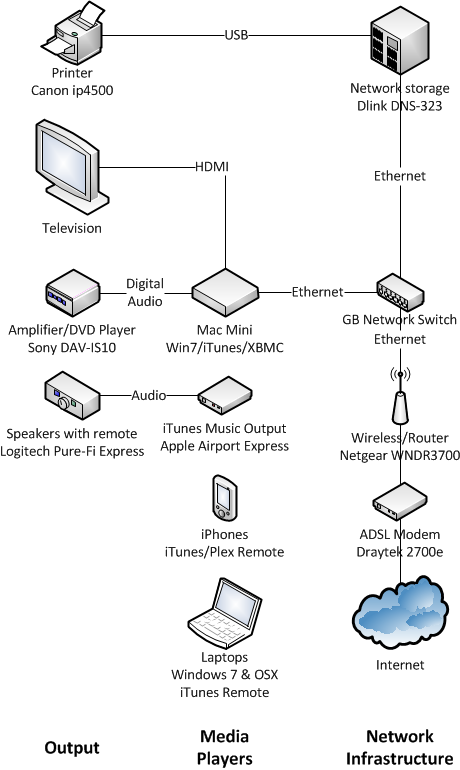
- Lounge – we use XBMC on the Mac Mini to play music, downloaded media and streaming Internet video. The all-in-one DVD player/amplifier is still used to watch movies on DVD.
- Bedroom – we use an Airport Express to play music from the network storage via iTunes running on the Mac Mini in the lounge. Our iPhones are used as remote controls. (Yes, there are a lot of systems involved in that process. Amazing that it works so well!)
- General – centralised storage of data, printing from anywhere, wireless Internet.
The Diagram
And here’s all the bits and how they connect up. As you can see it’s organised into three columns – output devices, players and network infrastructure:
Major Changes
The major changes since the last update:
- Dumped the old Xbox hardware for a media player and replaced it with an only slightly broken surplus Mac Mini running Windows 7. It’s still running XBMC. (Plex on OSX was rejected due to being a bit too unfinished – and I ended up hating the Apple Remote for not having enough buttons.)
- Upgraded the wireless network to dual-band 802.11n and the wired network to gigabit ethernet for maximum performance.
- Upgraded the network storage from 2 x 500Gb drives to 2 x 1.5TB drives, while still using the same old Dlink DNS-323 hardware.
- Switched to an ADSL internet connection due to not being able to get cable any more. We ended up having to run PPPoE from the ADSL modem to the router to make the connection stable enough to use.
- Added iTunes on the Mac Mini to enable use of an Airport Express as a remote music player.
- Added a Logitech Harmony remote (not shown) to control it all. This has allowed us to dump the other three remotes into a drawer and ignore them.
- Added an Xbox 360 (not shown) for gaming.
Next
It’s all working pretty well at the moment so no major changes are planned. The only limitation is that the Mac Mini isn’t powerful enough to play high-quality 1080p video. This could be solved by upgrading the hardware or by replacing it with a dedicated media player – if they ever get good enough (keeping my eye on the Boxee Box and the WD Live Hub). It doesn’t worry me too much at the moment.
Questions?
Feel free to ask any questions and I’ll do my best to answer them.
I was taken aback by what I found in my post box today – a letter asking me to complete a survey about my respiratory health. The Medical Research Institute tells me that (link to scan of letter (PDF)):
You have been randomly selected from the electoral roll to participate in the first phase which involves completing the questionnaire on the other side of this letter.
Personally I thought that it was illegal to use the Electoral Roll for any purpose other than elections, but it seems that there is an exception for approved scientific/health researchers.
I’d be surprised if the response rate was very high or very representative.
And no, I didn’t fill it out. Feel free to use the code and URL on the letter to go and answer it for me.
I was looking at the just released consultation document on Regulations and Codes of Practice for the Anti-Money Laundering/Countering the Funding of Terrorism Act.
They ask for submissions and add the following:
The Ministry of Justice does not intend to publish comment that it receives on this document. However any comment will be subject to the Official Information Act 1982 and may, therefore, be released in part or full.
This makes me feel like requesting all the submissions and publishing them (as Tech Liberty did for the ACTA submissions) just on general principle. Maybe if we keep doing that they’ll finally realise that it just makes more sense to publish the submissions themselves.
I really like the way that the iPhone recognises phone numbers in emails and turns them into touchable links.
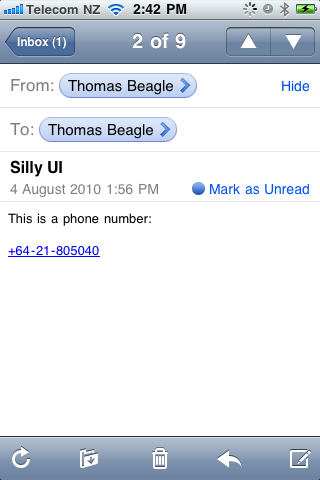
But for ages I thought that all you could do was call the number.

This used to really annoy me because, being a modern kind of person, I generally prefer to text people than call them. Other times I just wanted the number to add to my address book, so I’d end up cutting and pasting the number into Contacts.
Then one day I lingered on the link too long and a whole new menu popped up! Hey, here were exactly the features I was looking for.
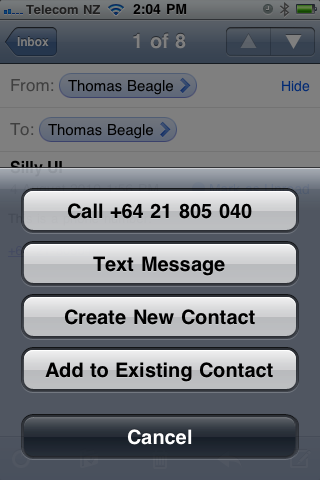
Now, there are two problems here.
Firstly, there is no advantage to the user from this arrangement. In both cases the phone displays a menu with one or more actions and an option to cancel it. The required user actions are the same:
- Press (or press and hold)
- Press selected option or cancel
If the user interaction is exactly the same why not just show the full menu in both cases?
Secondly, and more importantly, this “press and hold” functionality is hidden from the user and there’s no way to easily discover it. I’d had my phone for a couple of years before I realised it was there (I’m assuming it wasn’t added in an OS upgrade) and I wonder how many people still don’t know about it. And what other convenient features am I missing just because I haven’t thought to check that they might be there?
To my mind, “press and hold” is a user-unfriendly way to add functionality and should be avoided wherever possible.
Last week I went to my first Select Committee hearing and therefore I’m now an expert. Here’s what I found out.
Why
The New Zealand Council for Civil Liberties sent in a submission about the Electoral (Disqualification of Convicted Prisoners) Amendment Bill to the Law and Order Select Comittee.
Current law says that prisoners given a sentence of longer than 3 years cannot vote; this bill extends that to all prisoners. The Council opposes this change and recommends that this provision should be removed from the law, not extended.
In our submission we asked to make an oral submission to the committee.
Subsequently we received an invitation to appear before them. We were allocated 10 minutes to make our submission. Kevin was to do the submission while I went to support him.
Where
We turned up at Parliament 20 minutes before our time and went through the main visitor entrance. The receptionist asked us our business, gave us a sticker and then pointed us in the direction of the hearing rooms. The door was closed and a sign said that it was closed to the public. We sat down and chatted to the other submitters.
How
Eventually (they were late) the committee finished what they were doing, a whole bunch of people in suits filed out, and the sign on the door was changed to show that it was open to the public. We all filed in and sat in the public seats at one end of the room.
At the other end was a large U-shaped table with the various MPs around it, each with a computer terminal and a sign with their name in front of them.
What
The proceedings of the committee were fairly relaxed. The chair of the committee invited us up, quickly did introductions around the table and then asked us to speak.
Kevin gave his presentation and then the committee asked questions. The questions were generally quite good and showed that the committee members had listened to what he was saying – although some were obviously using our submission as a launch pad to put forward their own points of view. One committee member even asked for a copy of the statistics we had included in the presentation and then raced off to take copies.
Then the questions stopped and it was time for the next submitter to make their presentation, so we made our way out.
Acknowledgements
Thanks to Kevin McCormack of the NZ Council for Civil Liberties who wrote the original submission and then prepared and presented the oral submission.
Companies are increasing their use of Twitter but it’s not always obvious what they should be doing on it.
It doesn’t help that different people have different opinions. I’m not interested in following companies to get deals or beg for favours, and I detest “retweet to win” contests that try to turn everyone into unpaid spammers.
Here’s five times that companies made a positive impression on me by interacting over Twitter:
- Welcomed Whittakers (@whittakersnz) to Twitter and asked when they were going to do Easter Eggs. Got told they were working on it.
- Orcon offered to help me resolve a problem with their service. (Not solvable by them, it needed Telecom to pull finger.)
- I complained about Netgear service and got a phone call (!) from their PR company in Australia. I declined their offer to help and sorted it out through the usual channels the next day.
- Responded to a question about where to get batteries by suggesting Dick Smith. Someone else responded and speculated that their house-brand batteries might not be as good. @DickSmithNZ responded with details of their current sale on batteries as well as a link to a report showing that their batteries were as good as the name-brand ones.
- I said I was switching from Vodafone to Telecom and received a “Welcome on board” from @TelecomNZ.
Each of these companies treated me as a person and, by doing so, made me feel better about dealing with them.
The winner is Dick Smith for their quick and useful response – but I admit I’m still hanging out for those easter eggs from Whittakers!
Just having a look at the Summary Offences Act to see if it was illegal to be drunk in public (apparently it’s not) and found these:
Defence for public urination
Every person is liable to a fine not exceeding $200 who urinates or defecates in any public place other than a public lavatory. It is a defence in a prosecution under this section if the defendant proves that he had reasonable grounds for believing that he would not be observed.
Rewards
Every person is liable to a fine not exceeding $200 who Publicly advertises a reward for the return of any property that has been stolen or lost, and in the advertisement uses any words to the effect that no questions will be asked;
Postering
Every person is liable to a fine not exceeding $200 who, without the consent of the owner or occupier affixes any placard, banner, poster, or other material bearing any writing or pictorial representation to any structure, or to or from any tree;
Disturbing people
Every person is liable to a fine not exceeding $200 who, in any public place, unreasonably disrupts any meeting, congregation, or audience.
Peeping only happens at night
Every person is liable to a fine not exceeding $500 who is found by night without reasonable excuse peeping or peering into a dwellinghouse;